
Course
CLAT-PG
A state-based examination seldom knocks…… BE PREPARED

CC prepares aspirants through a focused, concept-driven programme covering in-depth subject knowledge of Constitutional Law, Jurisprudence, Administrative Law, Contract, Torts, Criminal Law, International Law, Family Law, Property Law, Company Law, Environmental Law, and current legal developments.
It is a comprehension-based test built on advanced legal passages and analytical MCQs to secure a seat in premier National Law University to pursue LL.M. Additionally, CLAT PG scores are also used by leading Public Sector Undertakings and government bodies for legal recruitment, as well as for shortlisting candidates for Judge Advocate General (JAG) entries in the armed forces and other law officer positions.
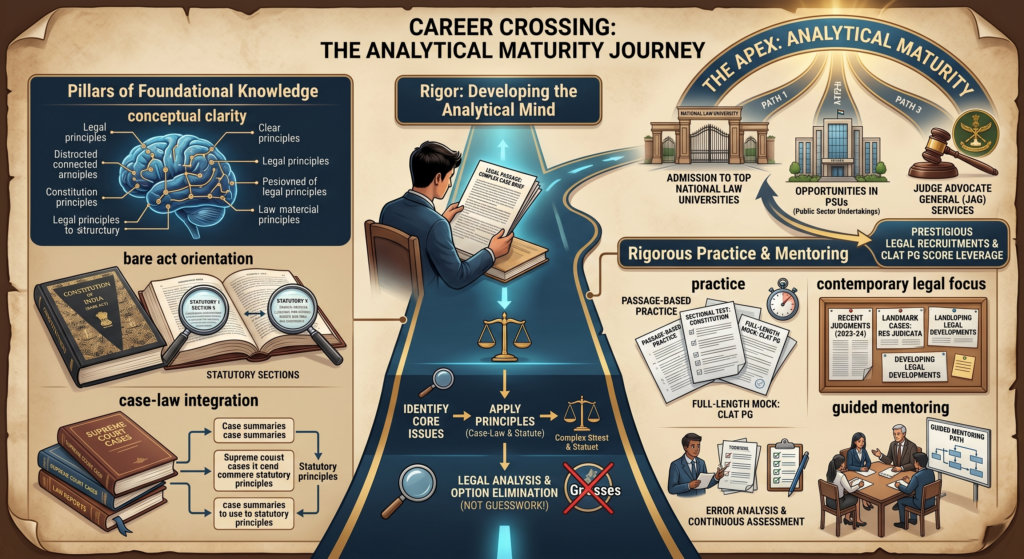
For preparation, CC emphasizes deep conceptual clarity, Bare Act orientation, and case-law integration to strengthen statutory interpretation and legal reasoning.
Students are rigorously trained to read complex legal passages, identify core issues, apply principles accurately, and eliminate options through precise legal analysis rather than guesswork.
Regular passage-based practice, sectional tests, full-length mocks, and strategic revision ensure accuracy, speed, and confidence.
Special attention is given to recent judgments, landmark cases, and contemporary legal developments to align preparation with the evolving nature of the exam.
Through continuous assessment, error analysis, and guided mentoring, CC enables students to develop the analytical maturity required not only to excel in CLAT PG and secure admission to top National Law Universities, but also to leverage their CLAT PG scores for opportunities in PSUs, JAG services, and other prestigious legal recruitments.
Student Voices
Words from Our Alumni
Common Questions
Frequently Asked Questions
What is the pattern of the CLAT PG examination?
CLAT PG is a comprehension-based examination built around advanced legal passages followed by analytical MCQs. The test evaluates a candidate’s ability to interpret statutes, understand legal principles, and apply case laws through precise legal reasoning rather than rote learning.
How does CC prepare students for the comprehension-based nature of CLAT PG?
CC trains students to read complex legal passages, identify core issues, apply correct legal principles, and eliminate options through structured legal analysis. Regular passage-based practice, sectional tests, and full-length mock tests ensure accuracy, speed, and confidence.
Which subjects are covered in CC’s CLAT PG preparation program?
The program provides in-depth conceptual coverage of Constitutional Law, Jurisprudence, Administrative Law, Contract, Torts, Criminal Law, International Law, Family Law, Property Law, Company Law, Environmental Law, along with current legal developments and recent judgments.
Why are Bare Acts and case laws emphasized in CC’s preparation strategy?
CLAT PG tests statutory interpretation and legal reasoning. CC emphasizes Bare Act orientation and integration of landmark and recent case laws to strengthen conceptual clarity and the ability to apply law accurately in passage-based questions.
How can CLAT PG scores help beyond LL.M. admissions?
Apart from securing admission into premier National Law Universities for LL.M., CLAT PG scores are also considered by Public Sector Undertakings (PSUs), government legal bodies, and for Judge Advocate General (JAG) entries in the armed forces, as well as other prestigious law officer recruitments. CC’s mentoring helps students leverage these opportunities effectively.
Does CC provide one-on-one personal attention and mentoring to CLAT PG aspirants?
Yes. CC ensures individual mentoring and personal attention to every student through continuous assessment, error analysis, and guided feedback. Faculty members closely monitor each aspirant’s progress, clarify doubts, refine legal reasoning skills, and provide customized strategies to improve performance in passage-based questions, mock tests, and overall preparation for CLAT PG and related opportunities.